
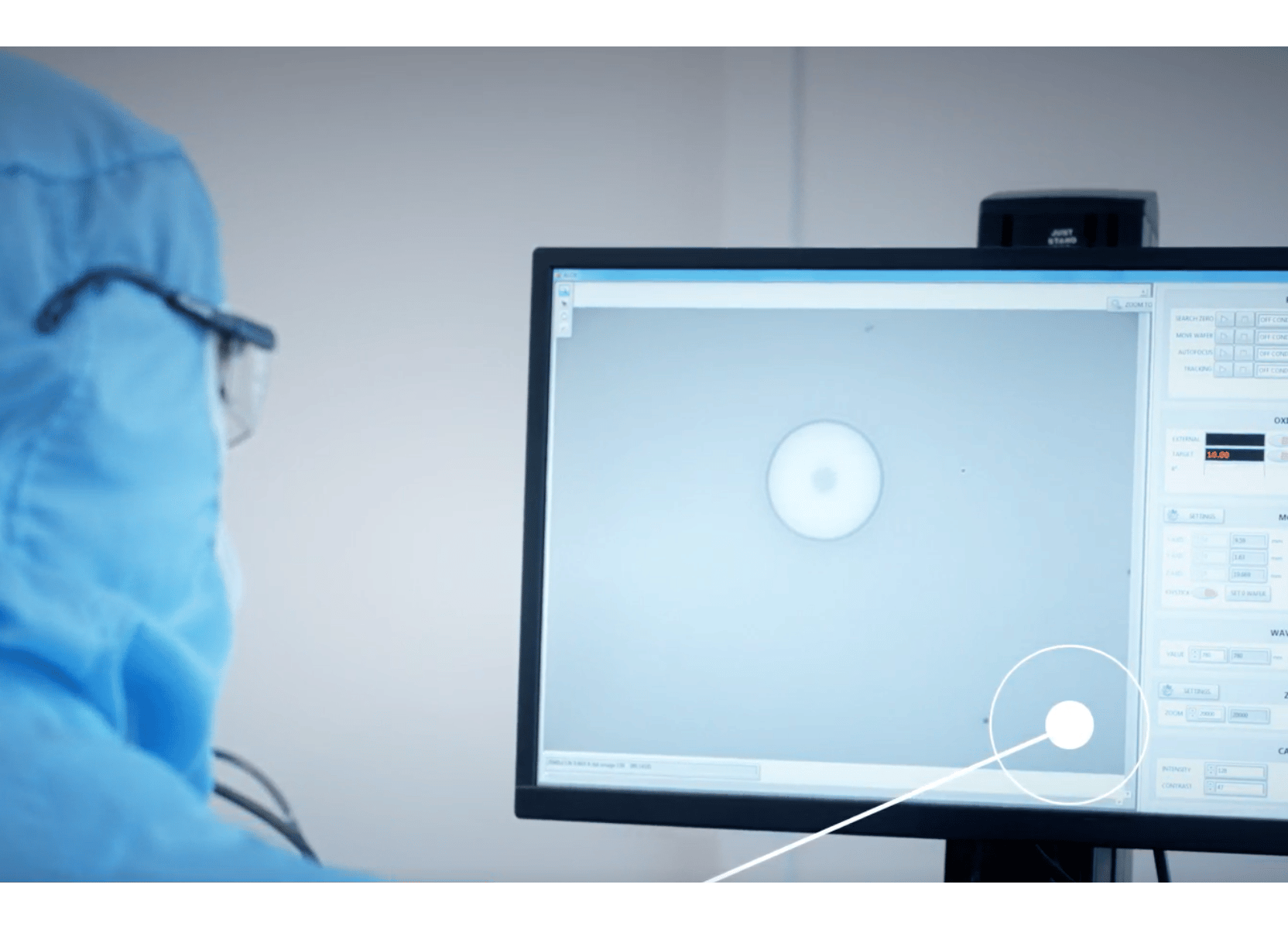
The world’s most precise wet oxidation equipment, engineered for the engineers who define VCSEL yield.
VCSEL wet thermal oxidation is a semiconductor process in which a buried AlAs or high-Al-content AlGaAs layer is converted into aluminium oxide (AlOx) through controlled exposure to water vapour. This process forms the oxide aperture, the key structure defining VCSEL performance, efficiency and reliability.
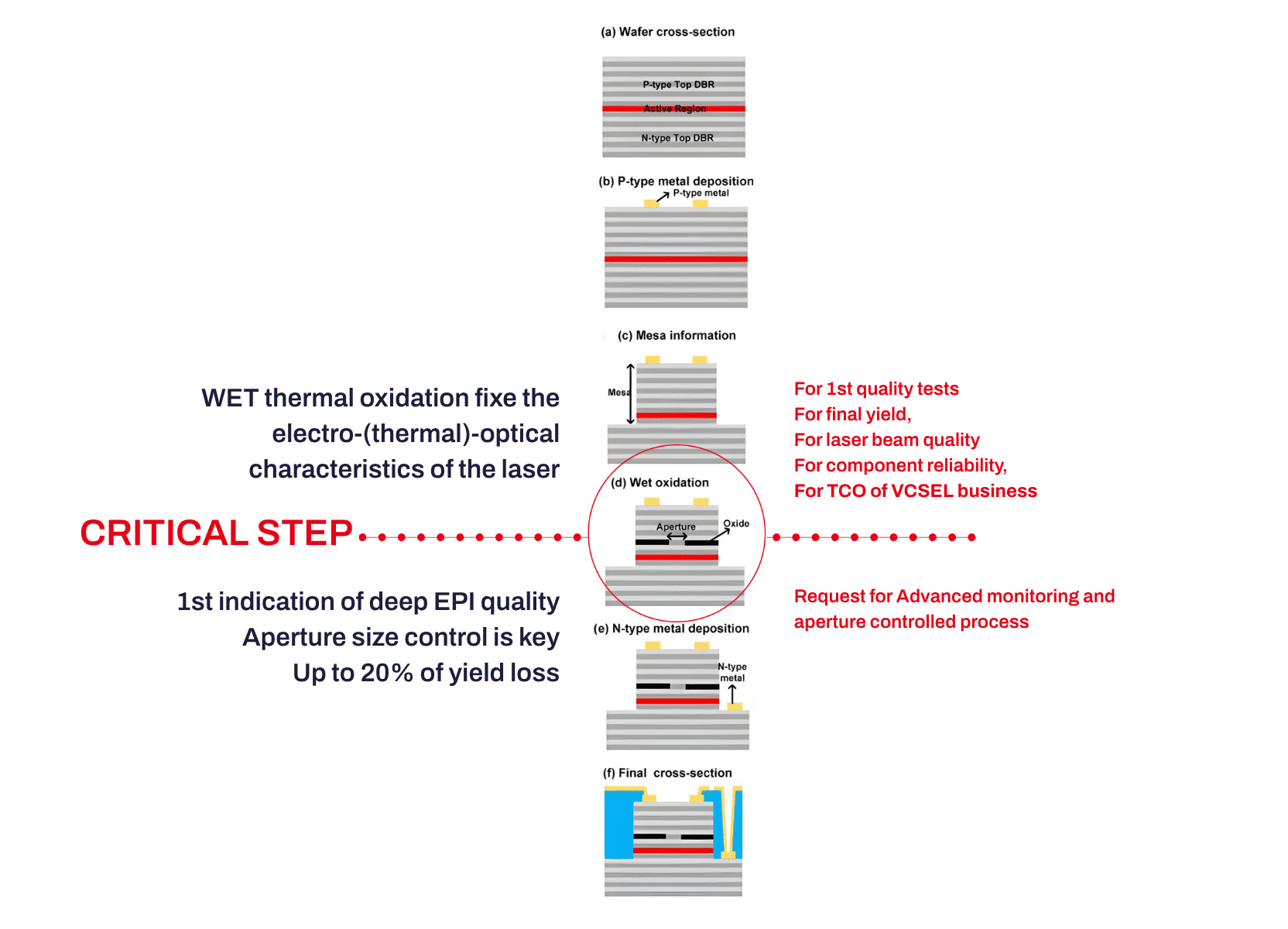
VCSEL wet thermal oxidation is the most critical step in VCSEL fabrication. VCSELs (Vertical-Cavity Surface-Emitting Lasers) are at the core of advanced applications such as high-speed datacom (800G–1.6T), 3D sensing, automotive LiDAR and precision industrial systems. Across all these use cases, device performance ultimately depends on a single, structurally decisive step: wet thermal oxidation.
During this process, a buried AlAs or high-Al-content AlGaAs layer is selectively converted into amorphous aluminium oxide (AlOx) through controlled exposure to water vapour at 350–600 °C. The reaction propagates laterally from the mesa sidewalls, forming a precisely defined oxide aperture at the centre of the device. This aperture is the key structure that governs the electro-optical behaviour of the VCSEL.
The aperture diameter directly impacts threshold current and efficiency, while its position defines the emission wavelength through the effective refractive index. Its shape, particularly its circularity, determines mode quality and beam stability. In parallel, the integrity of the AlGaAs/AlOx interface defines long-term reliability under thermal cycling. No downstream process can compensate for defects introduced at this stage.
From a manufacturing perspective, wet oxidation is also the primary yield driver. In conventional furnaces using time-based control, this step alone can account for up to 20% of first-pass yield loss. It is therefore both the most impactful and the most technically demanding step in the entire VCSEL fabrication flow.

The physics of wet thermal oxidation creates four distinct axes of process control, each carrying direct and measurable consequences for production economics and device performance. Understanding these axes is the prerequisite for understanding why the ALOXTEC portfolio equipment produces results that conventional furnaces cannot replicate. These four challenges define the operational limits of conventional wet oxidation. The ALOXTEC portfolio equipment is specifically engineered to address each of them through dedicated process control layers.
The lateral oxidation rate is not a simple function of time and temperature: it depends on the local Al content of the epitaxial layer, local temperature gradients across the wafer surface, and run-to-run variations in water vapour delivery. Even a deviation of a few tenths of a micron from the target aperture diameter is sufficient to shift the threshold current of the device outside its specification window, alter its emission wavelength, and degrade its high-speed modulation characteristics. Over-oxidation closes the aperture and kills the device. Under-oxidation misses the target. Both outcomes produce scrap that no downstream step can recover.
Even in a well-controlled furnace, temperature and water vapour gradients within the chamber cause the oxidation front to advance at slightly different rates from die to die, and from wafer centre to wafer edge. The resulting spread in aperture diameters across the 6-inch or 8-inch wafer creates a population of devices with distributed threshold currents and wavelengths, reducing the fraction of dies that fall within specification and directly compressing binnable yield.
Chamber conditioning, water vapour delivery calibration, and thermal stabilisation must be reproduced identically across hundreds of consecutive process cycles. Any systematic drift, whether in water flow, temperature ramp profile, or chamber cleanliness, accumulates into a yield offset that shifts unpredictably between lots. This makes it impossible to establish stable production margins without costly over-processing buffers.
High-pressure oxidation conditions trap arsenic-containing by-products, primarily arsine (AsH3), inside the forming AlOx layer. This creates aperture size deviation. Combined with the volumetric expansion stress inherent to the AlAs to AlOx conversion reaction, these defects accumulate under thermal and electrical cycling and eventually cause delamination of the oxide layer from the surrounding semiconductor. This delamination is the dominant field failure mode in VCSELs and high-power EELs, and the primary root cause of failures in AEC-Q102 automotive qualification programmes.
The ALOXTEC furnace is not a conventional wet oxidation equipment with an added camera. It is a ground-up engineering equipment built around a single objective: delivering deterministic, measurable, repeatable aperture control on every wafer, every run, across the full range of III-V epitaxial structures encountered in VCSEL and EEL manufacturing. Four integrated technology layers, each addressing a specific failure mode of conventional furnaces, together constitute the ALOXTEC performance advantage.
Three independent process parameters are controlled with closed-loop precision across the full ALOXTEC process window. Temperature, adjustable from 350 °C to 600 °C, is the primary driver of oxidation kinetics. It controls the rate of the AlGaAs to AlOx conversion reaction while requiring precise uniformity compensation at higher temperatures, where sensitivity to local Al content variations becomes more pronounced. Water flow, controllable from 0.6 to 30 g/h, governs oxide morphology, aperture shape, and long-term reliability: starving water conditions, i.e. a deliberately sub-stoichiometric water activity, are essential for producing dense, low-stress oxide layers that resist delamination under thermal cycling. Chamber pressure, the parameter most directly linked to reliability, operates across a range from a few millibar to 800 mbar. Uniquely low-pressure conditions allow arsine gas to degas efficiently from the forming oxide layer, preventing the trapped gas pocket formation that creates interfacial voids in conventional high-pressure furnaces.
The interdependency of these three parameters, and the ability to navigate the full three-dimensional T/H/P space with precision, is what enables ALOXTEC process engineers to optimise aperture geometry, uniformity and reliability simultaneously, rather than trading one off against another.
Conventional wet oxidation furnaces stop based on time: a predetermined duration calculated from a nominal oxidation rate established during process qualification. This approach has a fundamental incompatibility with the precision requirements of high-yield VCSEL production, because the oxidation rate is not a constant. It varies with local temperature gradients, run-to-run chamber conditioning, incoming EPI Al content variations from wafer to wafer, and the specific epitaxial structure being processed. No time-based recipe, however carefully optimised, can compensate for these variables in real time. The result is a systematic spread in aperture sizes across runs, across wafers within a run, and across dies within a single wafer.
The ALOXTEC equipment portfolio replaces this paradigm entirely. Rather than inferring the process endpoint from time and a calibrated rate model, ALOXTEC measures the oxidation front directly, continuously, and in real time, then terminates the process automatically when the target aperture size is reached. This is the Stop-on-Aperture function: a patented automation capability that delivers zero over-oxidation on every run, regardless of incoming EPI variability or run-to-run process fluctuations.
The Stop-on-Aperture function is enabled by ALOXTEC’s proprietary in-situ vision system, an optical measurement technology engineered in-house and fully integrated into the furnace chamber. An X/Y/Z motion system provides full-wafer spatial coverage, scanning freely across the entire wafer surface rather than measuring from a fixed point. A dual-camera configuration operates simultaneously throughout the run: a low-magnification camera provides the wafer-level uniformity overview, while a high-magnification camera resolves individual mesa structures at sub-micron scale for precise aperture tracking. Monochromator capability enables real-time, wavelength-selective imaging of the VCSEL emission during the oxidation cycle, providing direct measurement of the emitting wavelength as a function of oxidation depth without any additional metrology step or wafer transfer. Automatic mesa recognition software identifies all mesa structures on the wafer at run start, without manual template definition or operator input. When the target aperture size is reached, down to 3 µm, the Stop-on-Aperture algorithm triggers automatic process termination.
While Stop-on-Aperture ensures global process accuracy by controlling the endpoint, UniformPerf specifically addresses spatial non-uniformities across the wafer. Oxide aperture uniformity across the wafer is the direct determinant of yield in VCSEL production. Every additional tenth of a micron of uniformity error translates into a measurable fraction of dies falling outside the threshold current or wavelength specification window. At the volumes demanded by consumer electronics and AI datacom applications, where a single production lot may contain hundreds of thousands of VCSEL dies, the economic impact of non-uniformity is measured in yield points per wafer, and yield points translate directly into cost-per-good-die.
The root cause of aperture non-uniformity is spatial: local temperature and water vapour gradients within the furnace chamber cause different regions of the wafer to oxidise at slightly different rates. A wafer centre that is fractionally hotter than the edge, or that receives marginally more water vapour, will develop a larger aperture, even when the Stop-on-Aperture function terminates the global process at the correct mean aperture size.
UniformPerf© is ALOXTEC’s patented hardware and software option, engineered specifically to address these gradient-driven non-uniformities at their physical source. It combines active thermal gradient compensation, which modifies the spatial temperature field within the chamber to counteract the natural asymmetries of the furnace geometry, with enhanced flow field homogenisation that delivers more uniform water vapour distribution across the full wafer surface. The result is a step-change improvement in wafer-level uniformity that operates transparently within the existing oxidation cycle, without any modification to the process recipe and without any impact on cycle time.
UniformPerf© has been validated on 6-inch production wafers from Tier 1 VCSEL manufacturers, using a 37-point measurement grid with a 5 mm edge exclusion, which is the standard characterisation protocol for production yield assessment:
| Performance metric | ALOX (Standard) | ALOX UniformPerf© (Option) |
|---|---|---|
| Aperture uniformity (min-max, 6″ wafer) | ±0.6 µm | ±0.3 µm |
| Run-to-run deviation (sigma) | < 0.2 µm | < 0.1 µm |
| Performance gain vs. standard | Reference | > 2x improvement |
| Availability | Standard | Factory option or field upgrade |
UniformPerf© is compatible with all ALOX GEN1.4 furnace (Manual and Auto) and is available both as a factory-installed option on new equipment and as a field upgrade kit for existing installations.


The long-term reliability of a VCSEL is determined during the oxidation step, not during packaging, burn-in, or final test. The primary field failure mode in VCSEL and high-power EEL devices is delamination of the AlOx layer from the surrounding AlGaAs semiconductor, driven by residual stress that accumulates at the interface under sustained thermal and electrical cycling. This stress has two distinct physical origins, both rooted in the conditions under which the oxide layer forms.
The first mechanism is arsine entrapment. The wet thermal oxidation reaction converts AlAs or AlGaAs to AlOx while releasing gaseous by-products, of which the most consequential is arsine (AsH3). At the elevated pressures used in conventional wet oxidation furnaces, this gas cannot escape efficiently from the forming oxide layer: it becomes partially trapped within the AlOx matrix, creating aperture size deviation. These defects are invisible to post-process inspection but act as initiation sites for delamination under the mechanical stress of thermal cycling. The second mechanism is volumetric expansion stress: the conversion of AlGaAs to AlOx involves a density change at the reaction front, generating a volumetric expansion that induces compressive stress at the interface. Under high water activity conditions, as used in many conventional furnaces, this expansion is poorly controlled, and the resulting residual stress accumulates with every thermal cycle the device experiences in service.
The ALOXTEC process addresses both mechanisms simultaneously through three design choices that are unique to the ALOXTEC portfolio equipment. Low-pressure operation, down to a few millibar, ensures that arsine generated at the reaction front can diffuse out of the forming oxide layer efficiently, rather than becoming trapped. Starving water conditions, i.e. a deliberately sub-stoichiometric water vapour activity, produce a denser, more stoichiometrically complete AlOx layer with lower intrinsic porosity and reduced volumetric expansion stress. Integrated post-oxidation annealing, performed at process temperature and within the same chamber without any wafer movement, relaxes the residual stress remaining in the oxide layer before the wafer cools to room temperature. Together, these three elements produce VCSEL oxide layers that consistently demonstrate superior performance in accelerated reliability testing, including AEC-Q102 thermal cycling and operating life qualification protocols used by Tier 1 automotive photonics suppliers.

Every ALOXTEC equipment integrates three critical process functions within a single chamber: wet thermal oxidation, full-wafer characterisation and post-oxidation annealing, all performed without wafer transfer. This is not a convenience feature, but a core architectural choice with direct impact on yield, cycle time and capital efficiency.
In-situ characterisation eliminates handling risks, contamination and delays associated with external metrology. More importantly, it provides real-time process data at endpoint, enabling immediate decision-making. Process engineers no longer detect uniformity deviations after multiple wafers—they identify them instantly, on the current wafer, with full spatial resolution.
Beyond its physical impact on oxide stress, the integrated annealing step also represents a key architectural advantage of the ALOXTEC portfolio. By maintaining the wafer at process temperature within a controlled atmosphere, ALOXTEC avoids thermal shock and reduces residual interfacial stress. This improves long-term reliability without adding equipment, process steps or handling cycles.
The operational impact is straightforward: one equipment replaces three. Capital expenditure is reduced, cleanroom space is optimised, cycle time is shortened, and contamination risks are eliminated.

At process endpoint, before wafer unloading, the ALOXTEC in-situ vision system delivers a complete, quantitative characterisation of the oxide layer across the full wafer. Five measurement outputs are generated simultaneously, providing a real-time, multi-dimensional view of process quality without post-process metrology.
| Measurement output | What it measures | Primary process control function |
|---|---|---|
| Oxidation depth map | Lateral AlOx extent at every measured mesa | EPI quality screening: first spatial indicator of Al content non-uniformity |
| Aperture size map | Oxide aperture diameter, die by die across the wafer | Yield prediction: direct predictor of threshold current and wavelength uniformity |
| Circularity index | Quantitative roundness of the oxide aperture at each mesa | Mode quality control for single-mode VCSEL and beam symmetry in LiDAR arrays |
| Mesa size map | Full mesa geometry: etch dimensions and shape | Cross-step root cause analysis: correlates oxidation uniformity with upstream etch variations |
| Emitting wavelength map | Real-time VCSEL emission wavelength across the wafer during oxidation | EPI quality and WDM channel alignment control: critical for datacom and LiDAR applications |
ALOXTEC’s authority in wet thermal oxidation of III-V semiconductors rests on a combination that few equipment suppliers can match: a 15-year scientific research partnership with leading academic institutions, and a production track record validated at the most demanding commercial VCSEL manufacturing sites in the world.

 Save as PDF