

Discover how ALOXTEC supports high-performance VCSEL manufacturing for data centers and AI infrastructure.
Artificial intelligence has become the primary driver of growth in the optical interconnect market. The deployment of large-scale AI training and inference clusters requires high-speed, short-reach optical links in unprecedented volumes, with continuous increases in bandwidth requirements across each generation of infrastructure.
In this context, VCSEL technology plays a central role in enabling cost-effective, high-performance optical interconnects within data centers. However, the increasing data rates, thermal constraints and integration density impose significantly tighter manufacturing tolerances than in previous datacom generations.
At production scale, manufacturing performance is driven by the ability to combine aperture precision, process repeatability and capacity ramp. Variability in critical process steps can directly impact bandwidth, wavelength control and long-term device reliability, making process control a key lever for performance and scalability in AI infrastructure applications.
This page translates the specific requirements of data centers and AI infrastructure into their manufacturing implications, and highlights how advanced process control strategies support high-volume, high-performance VCSEL production.

The deployment of large-scale AI training infrastructure represents a fundamentally different demand pattern for the optical interconnect supply chain compared to the gradual, predictable growth of conventional datacenter buildout. AI cluster deployments are discrete, capital-intensive procurement events: a hyperscale operator commissioning a new generation of GPU infrastructure requires thousands of optical transceivers to be available within a defined window, at a bandwidth specification that advances with each processor generation.
This demand pattern imposes two simultaneous pressures on VCSEL component manufacturers: the ability to respond to large-volume purchase orders with short lead times, and the ability to qualify and ramp new VCSEL designs that meet the bandwidth and reliability specifications of each new transceiver generation. Both pressures land directly on the wet oxidation step, where aperture control precision determines device bandwidth and process throughput determines ramp capacity.

Short-reach optical interconnects within AI clusters, spanning distances from chip-to-chip across a board to rack-to-rack across a row, rely almost exclusively on VCSEL-based parallel optics operating over multimode fibre. This technology dominates because it offers the lowest cost per gigabit at the power levels and distances relevant to intra-cluster communication, where energy efficiency is a primary design constraint and link distances rarely exceed a few hundred metres.
As AI cluster bandwidths have scaled from 100G to 400G to 800G and toward 1.6T aggregate per transceiver, the per-lane data rate of individual VCSEL emitters has increased correspondingly. This increase in per-lane bandwidth is not simply a matter of driving the device faster: it requires a fundamental improvement in the intrinsic electro-optical response of the VCSEL, which is determined by the aperture size and the optical confinement quality of the oxide layer. Achieving the modulation bandwidth required for next-generation datacom VCSELs demands aperture control precision that conventional timed oxidation processes cannot consistently deliver.
The AI datacenter optical interconnect landscape encompasses several distinct link types, each with specific VCSEL operating conditions that translate into specific requirements for the wet oxidation process.
| Optical interconnect type | VCSEL operating conditions | Wet oxidation process requirement |
|---|---|---|
| Intra-rack links (up to 100 m, multimode fibre) | 850 nm or 980 nm VCSEL arrays at 25 Gbps per lane. Low power consumption, high density, direct-drive from switch ASIC. | Aperture size directly controls modulation bandwidth. Smaller apertures support higher single-mode bandwidth but require ultra-tight Stop-on-Aperture precision. Array-level aperture uniformity determines channel-to-channel threshold current spread, which sets the driver headroom and power consumption budget of the optical module. |
| Inter-rack and top-of-rack links (100 m to 500 m, multimode fibre) | VCSEL-based parallel optics at 100G to 800G aggregate bandwidth. Thermal management is a primary design constraint at rack scale. | VCSEL thermal resistance is partially determined by oxide layer quality. Low-stress oxide layers produced by ALOXTEC low-pressure oxidation maintain lower thermal resistance under sustained high-power operation, contributing to the thermal budget available to optical module designers at high aggregate bandwidth. |
| Co-packaged optics (CPO) (on-package integration with switch ASIC) | VCSEL arrays operating in extreme proximity to high-power switch silicon. Thermal environment is the most demanding of any datacom application. No field serviceability. | Co-packaged optics impose the most stringent reliability requirement in the datacom segment: the VCSEL array must sustain its performance characteristics for the full operational lifetime of the switch, without any possibility of replacement. Oxide layer delamination resistance under sustained thermal load is the defining reliability criterion. ALOXTEC low-pressure oxidation and integrated post-oxidation annealing are required process characteristics. |
| 800G and 1.6T transceiver modules (pluggable, multimode and single-mode) | VCSEL arrays at 100 Gbps per lane or higher. Wavelength-division multiplexing (WDM) variants require precise wavelength control per channel. | At 100 Gbps per lane, VCSEL modulation bandwidth is determined by the intrinsic electro-optical response of the device, which is a direct function of aperture size and photon-electron interaction dynamics within the cavity. Ultra-tight aperture size deviation control is required to achieve the target bandwidth at the specified threshold current. For WDM variants, emission wavelength must be controlled within a few nanometres, directly constraining aperture size variability across the production lot. |
The most demanding datacom VCSEL applications, particularly co-packaged optics and high-lane-count 800G or 1.6T modules, require the simultaneous achievement of high modulation bandwidth, precise wavelength control and long-term reliability under extreme thermal conditions. These three requirements are not independently optimisable: they are coupled through the aperture size and the quality of the AlGaAs/AlOx interface produced during oxidation.
A smaller aperture improves single-mode bandwidth but requires more precise endpoint control to avoid yield loss from over- or under-oxidation. A more reliable oxide interface requires low-pressure process conditions that must be compatible with the aperture geometry and uniformity requirements. Navigating this multi-dimensional optimisation space is precisely the engineering challenge that the ALOXTEC T/H/P process control architecture, Stop-on-Aperture endpoint and low-pressure reliability process are designed to address simultaneously.

| AI context | AI constraints | Oxidation implications |
|---|---|---|
| Rapid volume ramp | AI cluster deployments are discrete, large-scale procurement events. A hyperscale operator committing to a new GPU cluster generation requires the optical interconnect supply chain to deliver hundreds of thousands of transceiver modules within a defined commissioning window. There is no gradual ramp: the requirement appears and must be met at full volume within months. | The oxidation capacity available at ramp must be qualified and ready. Process recipes must transfer without requalification from development equipment to production equipment. The 100% recipe portability between the ALOXTEC GEN1.4L Auto and the GEN2.0 HV Auto eliminates the qualification delay that would otherwise be incurred at the machine transition. |
| Wavelength stability across production lots | Optical transceivers for AI clusters are procured in large, homogeneous lots and installed in environments where WDM channel plans are fixed at the network architecture level. Wavelength drift between production lots creates channel alignment problems at installation that are expensive to diagnose and correct at rack scale. | Run-to-run aperture repeatability is the primary process lever for wavelength stability. The σ < 0.1 µm run-to-run deviation achieved with Stop-on-Aperture and UniformPerf© translates into a correspondingly stable emission wavelength distribution across production lots, reducing the risk of channel alignment issues at installation. |
| Zero unscheduled downtime in production | AI training clusters operate on continuous job schedules where unplanned interruptions have disproportionate economic impact. Optical link failures that cause cluster partitioning or job restarts represent significant losses at the AI operator level, and these costs propagate back into the component supply chain as reliability specifications and qualification requirements. | Long-term VCSEL reliability under continuous high-power operation is the process quality dimension that maps to this requirement. Low-pressure oxidation, water-limited process conditions and integrated post-oxidation annealing in the ALOXTEC equipment produce oxide layers with significantly lower interfacial stress and superior resistance to delamination under sustained thermal load. |
| SECS/GEM integration and full process traceability | Tier 1 optical module manufacturers supplying AI infrastructure operators operate fully automated production lines with host-controlled process management, real-time data streaming to MES, and lot-level traceability requirements that are contractually mandated by hyperscale customers. | Full SECS/GEM connectivity (SEMI E30, E37, E40, E42) on the ALOX GEN1.4L Auto and GEN2.0 HV Auto enables seamless integration into these automated production environments. Real-time streaming of process parameters and in-situ measurement data to the fab MES provides the lot-level traceability required by hyperscale procurement specifications. |
Hyperscale operators procuring optical transceivers at the scale demanded by AI infrastructure deployments increasingly impose component-level traceability requirements on their supply chains. Each transceiver module must carry a record of the key process parameters under which its VCSEL components were manufactured, enabling failure analysis at the component level if performance anomalies emerge in the field.
The ALOXTEC SECS/GEM interface provides the real-time process data streaming and per-wafer measurement records that form the basis of this traceability chain. The complete dataset, including process parameter traces, in-situ aperture maps and post-oxidation characterisation outputs for every production run, is available at the fab MES level and can be archived and retrieved per lot as required by hyperscale procurement specifications.


When a VCSEL manufacturer needs to expand oxidation capacity in response to an AI infrastructure procurement commitment, the conventional approach requires installing additional oxidation furnaces, developing and qualifying process recipes on each new equipment, and validating that the process performance on the new equipment is equivalent to the validated process on the existing equipment. This qualification process consumes engineering resources and calendar time that are rarely available when operating under the pressure of a hyperscale delivery window.
The ALOXTEC portfolio eliminates this bottleneck through 100% recipe portability across the machine range. A process recipe qualified on the ALOX GEN1.4L Auto runs on the ALOX GEN2.0 HV Auto without modification and without tool-specific requalification. The same Stop-on-Aperture target, the same UniformPerf© configuration, the same post-oxidation characterisation protocol, and the same acceptance criteria transfer directly between equipment.
This means that capacity expansion on the ALOXTEC equipment, is a logistics decision, not an engineering project. The time from equipment installation to first production wafer is the commissioning time of the equipment itself, not the commissioning time plus a recipe qualification campaign. For a VCSEL manufacturer responding to an AI infrastructure ramp commitment, this difference can represent weeks of lead time recovered at the moment of highest demand.
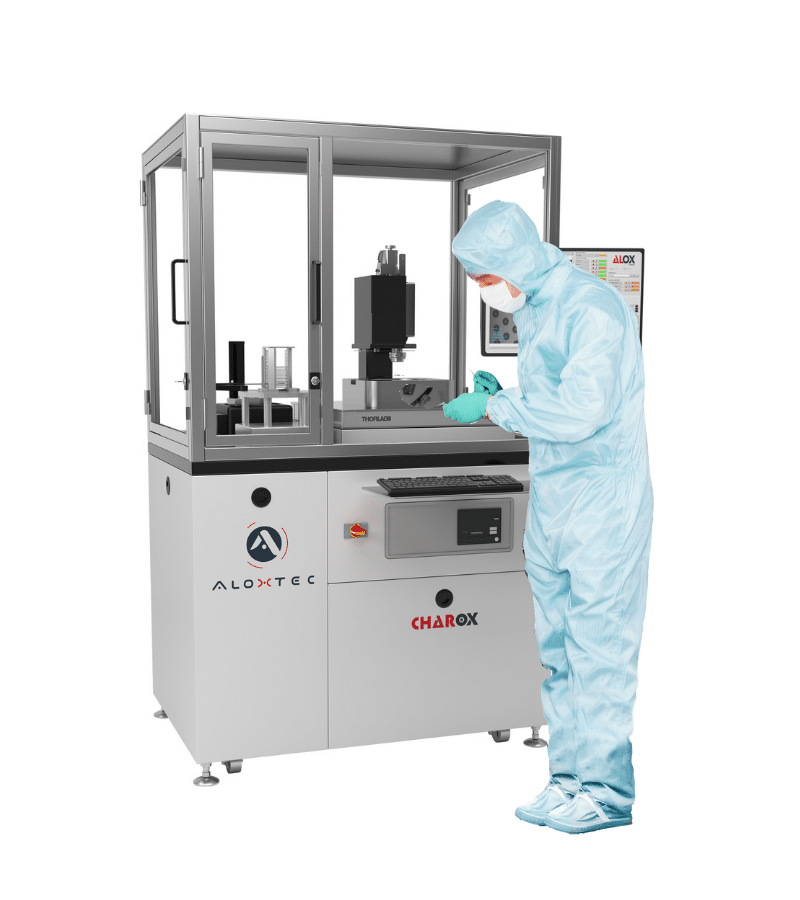
For datacom VCSEL manufacturers with an existing oxidation equipment solution who require ALOXTEC-grade characterisation capability without replacing their oxidation tool, the CHAROX 1.0 characterisation station provides the complete five-output measurement capability, including in-situ wavelength mapping, on a vibration-isolated optical table compatible with any oxidation process flow. The CHAROX 1.0 is particularly relevant for datacom applications where the emission wavelength map provides direct, production-run process data for WDM channel alignment validation.
ALOXTEC’s expertise in VCSEL manufacturing for data centers and AI infrastructure is based on advanced process control technologies and a proven track record in high-volume photonic production environments. The following questions address the specific challenges of VCSEL manufacturing at AI infrastructure scale.
 Save as PDF