
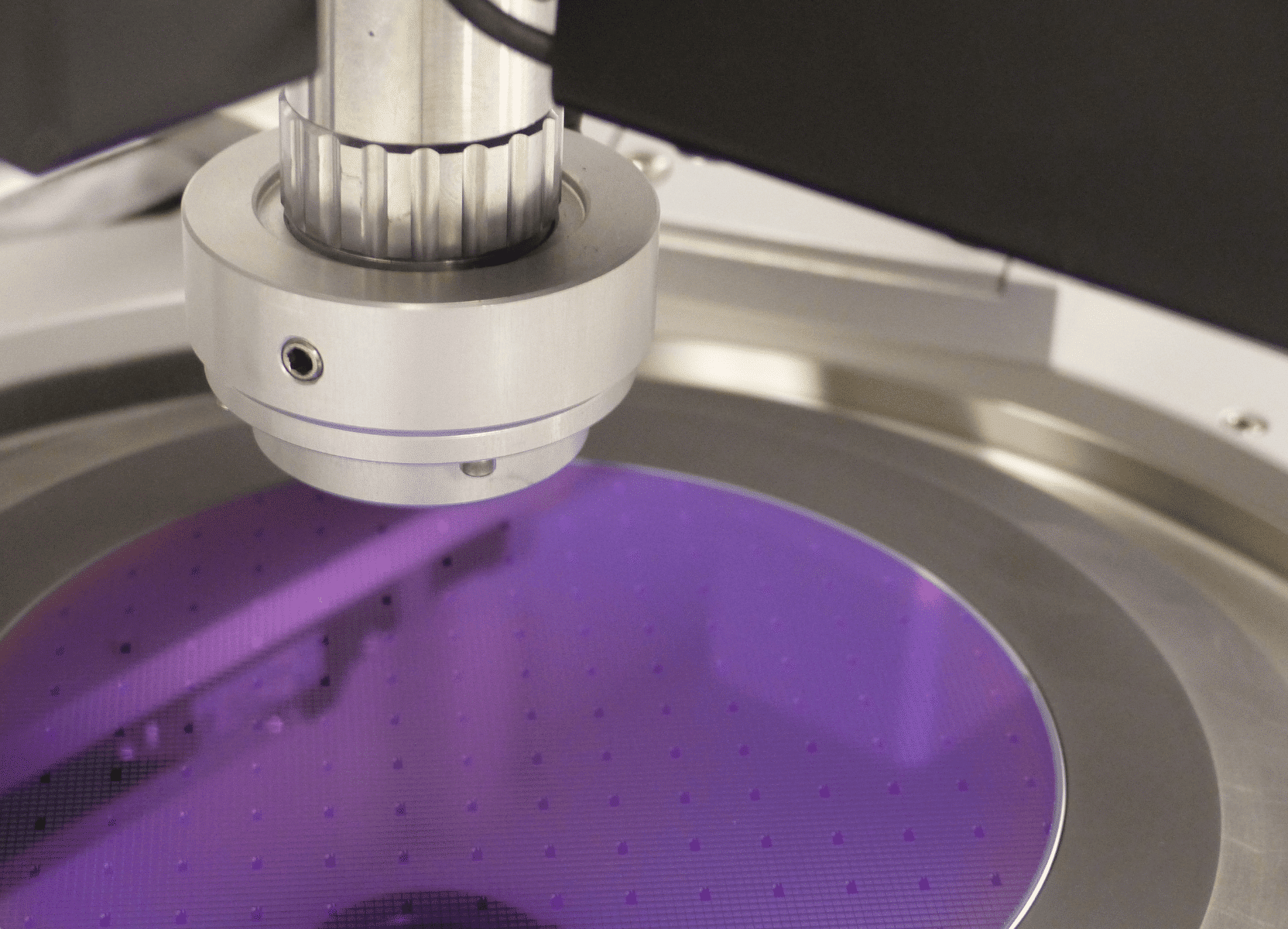
Precision wet oxidation for VCSEL, EEL, III-V waveguides and Silicon Photonics.
One equipment. Four application domains.
Wet thermal oxidation of AlAs and AlGaAs layers defines the structural, optical and electrical performance of III-V photonic devices. The formation of aluminium oxide (AlOx) enables current confinement, optical guidance and isolation across multiple application domains.
While simple in principle, the process is highly sensitive to temperature, water flow and chamber pressure. Precise control of these parameters is required to achieve consistent performance, high yield and long-term reliability at wafer scale.
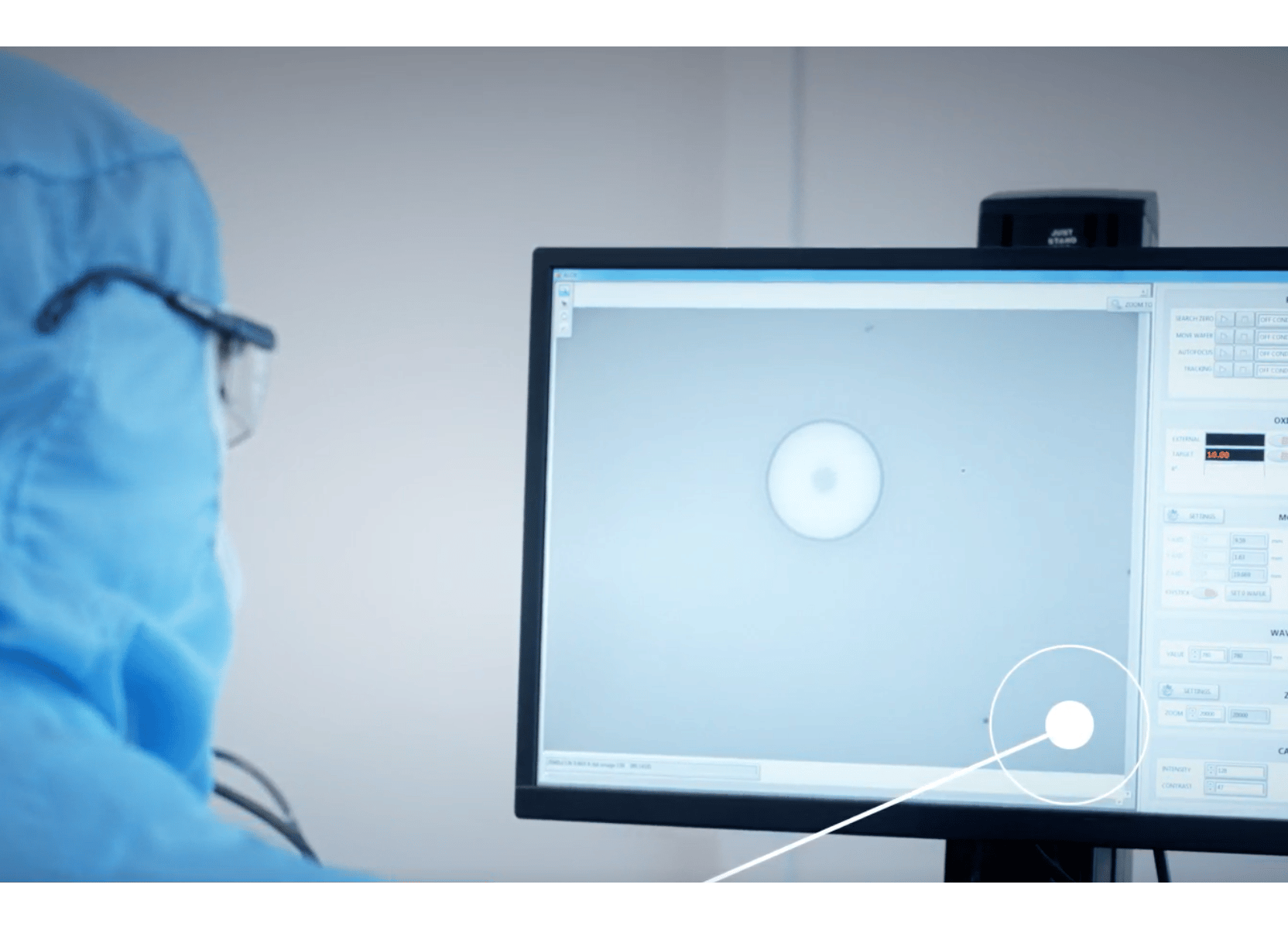
In Vertical-Cavity Surface-Emitting Laser fabrication, the wet oxidation step creates the oxide aperture that simultaneously confines current injection and optical mode in the laser cavity. Aperture diameter controls threshold current, emission wavelength and beam divergence. Aperture uniformity across a 6-inch wafer directly determines production yield. A deviation of a few tenths of a micron from the target aperture dimension can shift a device outside its electro-optical specification and result in die rejection. Conventional time-based oxidation cannot compensate for run-to-run variability in epitaxial aluminium content, local temperature gradients or chamber conditioning state. The ALOXTEC Stop-on-Aperture automation addresses this by monitoring the oxidation front in real time and terminating the process at the exact target aperture size, on every run, regardless of incoming wafer variability.

In Edge-Emitting Laser and laser diode manufacturing, wet thermal oxidation forms the current-blocking oxide regions on either side of the active ridge waveguide. The width of the unoxidized canal, the smoothness of the oxide-to-semiconductor interface, and the mechanical integrity of the AlGaAs/AlOx boundary all directly affect threshold current, slope efficiency, emitting wavelength and long-term device reliability under operating conditions.
Delamination of the AlGaAs layer at the oxide interface is the primary long-term failure mode in EEL components. It is driven by volumetric stress at the oxide boundary. The low-pressure oxidation architecture of the ALOXTEC equipment range, combined with starving water conditions, minimises this stress at formation and virtually eliminates delamination as a field failure mechanism.

In III-V photonic waveguide fabrication, the AlOx layer produced by wet thermal oxidation serves as a high-index-contrast cladding material. The refractive index of AlOx (approximately 1.6) versus that of surrounding AlGaAs (approximately 3.5) creates a confinement structure that defines the guided mode profile and propagation losses of the waveguide. In the most demanding geometries, the AlOx cladding depth must be controlled to achieve the required mode overlap and coupling efficiency.
This level of precision places III-V waveguide oxidation at the frontier of what wet thermal oxidation equipment must deliver: it exceeds the dimensional control requirements of VCSEL and EEL applications, and requires both the in-situ measurement capability and the process stability of the full ALOXTEC equipment range.

Silicon Photonics technologies provide an efficient passive optical infrastructure for routing, splitting and filtering light. They cannot generate or amplify it. III-V gain materials, integrated heterogeneously onto silicon substrates, provide the laser sources, semiconductor optical amplifiers and high-speed modulators that complete the photonic system. Wet thermal oxidation of AlAs or AlGaAs layers is the process step that creates the current-confining apertures and waveguide cladding structures essential to the performance of these III-V active components within hybrid silicon photonics devices and systems.
The process control requirements for Silicon Photonics integration combine the aperture precision demands of VCSEL manufacturing, the wavelength stability requirements of EEL fabrication, and the ultra-tight aperture size deviation control required for III-V waveguide processing. No simplified or partially controlled oxidation equipment can meet all three simultaneously at wafer scale.
The common requirement across all four application domains is process control that is deterministic, measurable and repeatable at wafer scale. ALOXTEC’s portfolio equipment addresses this with a unified three parameter T/H/P architecture, real-time in-situ vision and Stop-on-Aperture automation, and validated UniformPerf© aperture uniformity of min-max 0.3 µm on 6-inch wafers.
The same equipment serves Tier 1 production lines and R&D environments, with recipe portability that preserves process knowledge developed during device qualification through the full production ramp. Whether the application is a 3 µm aperture VCSEL for a co-packaged optics transceiver or an AlOx waveguide cladding layer for a photonic integrated circuit, the process control requirements converge on the same engineering answer.
Contact our Application Engineering team to discuss your specific oxidation challenge, or explore the application pages to find the detailed technical content relevant to your device and process context.
 Save as PDF