
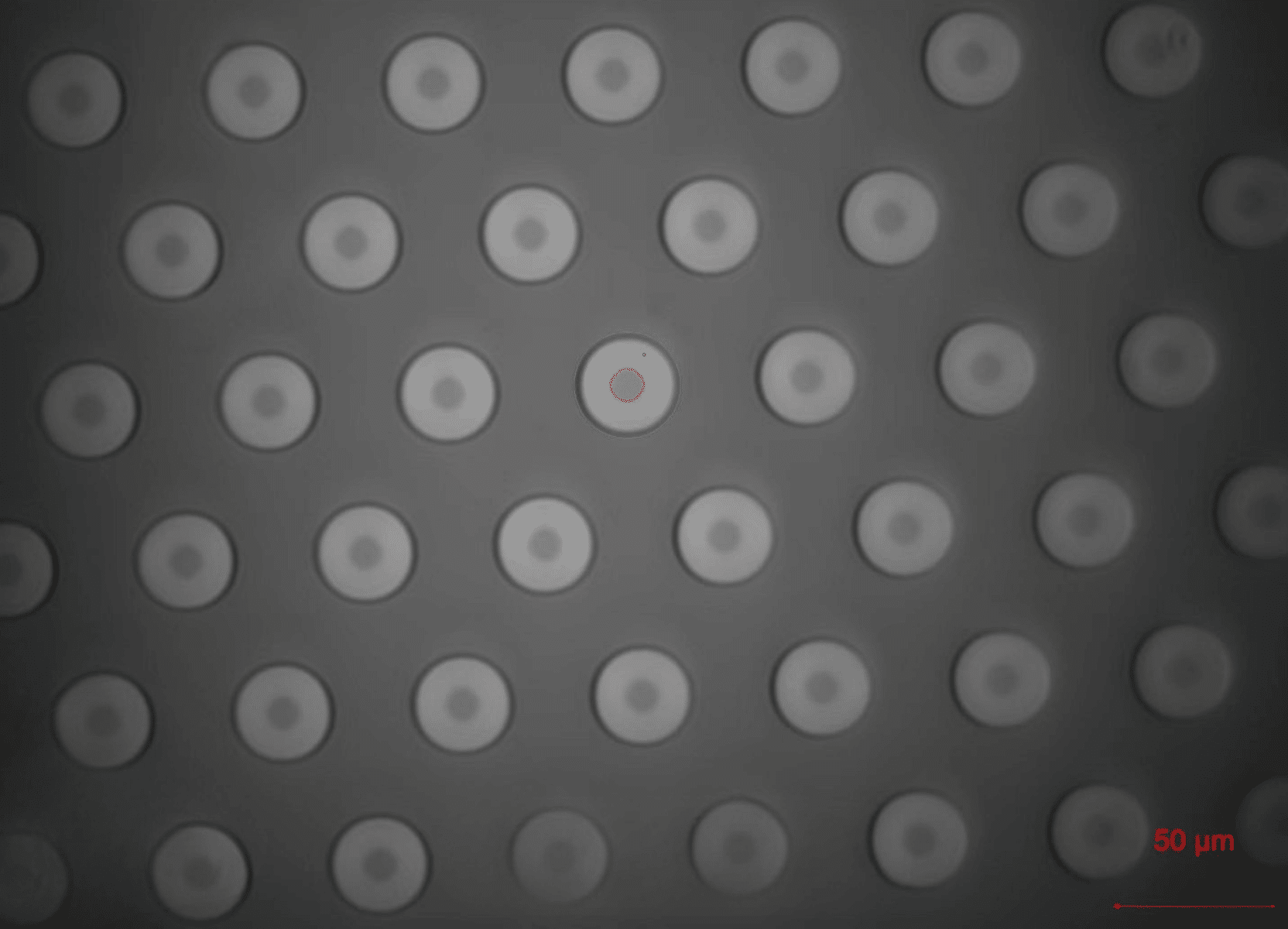
About VCSEL oxide aperture uniformity
Oxide aperture uniformity across a 6-inch or 8-inch wafer is the single most direct determinant of binnable yield in high-volume VCSEL manufacturing. Every tenth of a micron of additional aperture spread across the wafer corresponds to a measurable fraction of dies falling outside the threshold current, wavelength or modulation bandwidth specification window. At the production volumes required by consumer electronics, AI datacom and automotive LiDAR applications, this translates into a yield gap that compounds directly into cost per good die.
UniformPerf© is ALOXTEC’s patented hardware and software option, engineered specifically to address the root causes of spatial aperture non-uniformity in wet thermal oxidation. It does not improve the mean aperture accuracy, which is the function of the Stop-on-Aperture endpoint control described on the Oxide Aperture Control page. It acts on a fundamentally different problem: the spatial distribution of aperture sizes around that mean, across the full wafer surface.
This page explains why that spatial non-uniformity exists as a physical inevitability in any furnace-based wet oxidation process, what UniformPerf© does to eliminate its root causes, and what performance improvement it delivers as a validated, production-confirmed result.

Spatial aperture non-uniformity in wet thermal oxidation is not a calibration problem or a process recipe deficiency. It is a direct and unavoidable consequence of the physics of heat transfer and fluid dynamics within a sealed furnace chamber. Understanding this distinction is essential for understanding why UniformPerf© works where conventional process optimisation reaches its limits.
The lateral oxidation rate at any point on a wafer surface is determined by two local quantities: the temperature at that point, and the water vapour concentration at that point. Both quantities are governed by physical transport phenomena within the furnace chamber, namely heat conduction, convection and radiation for temperature, and mass transport and flow dynamics for water vapour. Both phenomena produce spatial distributions that are inherently non-uniform at the scale of a 6-inch or 8-inch wafer, for reasons that are intrinsic to the furnace geometry rather than the result of any manufacturing defect or process error.
The table below maps the four primary physical root causes of spatial aperture non-uniformity to their mechanisms and their diagnostic signatures in the characterisation data. Understanding these signatures is the prerequisite for deploying UniformPerf© effectively, because the compensation strategy is matched to the observed non-uniformity pattern.

| Non-uniformity source | Physical mechanism | Signature in the characterisation data |
|---|---|---|
| Radial temperature gradient (centre-to-edge) | The furnace chamber geometry creates a natural thermal asymmetry between the wafer centre and its periphery. The wafer centre, further from the chamber walls, tends to be at a slightly different temperature than the edge. Because oxidation rate is an exponential function of temperature, even a fraction of a degree of radial temperature difference produces a measurable centre-to-edge gradient in oxidation rate and therefore in aperture size. | Aperture size map shows a rotationally symmetric gradient: larger apertures at the wafer centre (if centre is hotter) or at the wafer edge (if edge is hotter). The oxidation depth map mirrors the same radial pattern. Circularity index is typically unaffected by a purely radial gradient. |
| Azimuthal temperature asymmetry | Non-uniform heating elements, asymmetric chamber insulation, or directional heat losses within the furnace geometry can create localised temperature differences that vary with angular position on the wafer. These produce an oxidation rate that is not rotationally symmetric, resulting in one region of the wafer oxidising faster than another at the same radial distance from the centre. | Aperture size map shows a one-sided or sector-specific gradient that does not follow radial symmetry. Correlation with the oxidation depth map confirms a furnace-origin mechanism. Circularity index may show directional bias at affected dies. |
| Water vapour distribution gradient | Water vapour is introduced into the furnace chamber through a delivery system designed to produce a homogeneous vapour field across the wafer surface. In practice, local flow dynamics within the chamber create regions of slightly higher and lower vapour concentration. Because water vapour activity directly influences oxidation rate, these concentration gradients translate into corresponding aperture gradients, independently of the temperature field. | Water vapour gradients produce aperture non-uniformity patterns that may not correlate with the temperature-driven patterns. They can appear as directional gradients aligned with the vapour inlet geometry, or as localised anomalies in specific regions of the wafer. Correlation analysis between multiple runs is required to distinguish vapour-origin from temperature-origin patterns. |
| Interaction between thermal and vapour gradients | In practice, the thermal gradient and the vapour distribution gradient coexist within the chamber and interact. A region that is both slightly hotter and slightly richer in water vapour will oxidise at a rate that reflects both contributions simultaneously. The superposition of these two gradient fields produces the observed spatial aperture pattern, which may be complex and not directly interpretable from a single measurement output without correlation analysis. | Complex, asymmetric aperture patterns that combine radial and azimuthal components. Full decomposition of the contributing gradient sources requires correlation of the aperture map with process parameter logs (temperature traces, water flow records) and, for systematic optimisation, targeted process experiments varying T and H independently. |
The natural response to spatial aperture non-uniformity in a standard oxidation process is to optimise the T/H/P recipe: adjust temperature, modify water flow, change pressure, and iterate until the uniformity improves. This approach can reduce non-uniformity to a degree, but it reaches a fundamental limit imposed by the furnace geometry itself.
Temperature and water vapour gradients within the chamber are not artefacts of a poorly chosen recipe point. They are structural features of the heat transfer and fluid dynamics environment inside the furnace, determined by the geometry of the heating elements, the chamber walls, the gas inlet and exhaust ports, and the position of the wafer within the chamber. A recipe optimisation that improves uniformity at one T/H/P operating point may not transfer to a different operating point required by a different epitaxial structure. And because the gradient patterns evolve with chamber conditioning state over the course of a production campaign, a recipe optimised at one point in time may drift out of specification over weeks or months of continuous operation.
UniformPerf© addresses this limitation by acting directly on the physical fields that produce non-uniformity, rather than on the recipe parameters that influence those fields indirectly.
UniformPerf© combines two hardware and software mechanisms that act on the two independent physical sources of spatial aperture non-uniformity: the thermal gradient field and the water vapour distribution field. The two mechanisms are complementary and non-redundant: each addresses a source of non-uniformity that the other cannot reach.
| UniformPerf© mechanism | Non-uniformity source it addresses | How it acts on the process |
|---|---|---|
| Active thermal gradient compensation | Radial and azimuthal temperature non-uniformity within the furnace chamber. The spatial temperature field across the wafer surface determines the local oxidation rate at every point, and any deviation from perfect uniformity translates directly into aperture non-uniformity. | UniformPerf© modifies the spatial temperature field within the chamber to counteract the natural asymmetries of the furnace geometry. The compensation is active and closed-loop: it responds to the actual thermal state of the chamber during each run, rather than applying a fixed correction derived from a calibration measurement. This means the compensation remains effective across the full T/H/P (Temperature / Humidity / Pressure) process window and adapts to changes in chamber conditioning state over time. |
| Enhanced flow field homogenisation | Water vapour concentration gradients across the wafer surface. Non-uniform vapour distribution produces local oxidation rate differences that are independent of the temperature field and therefore not addressable by thermal compensation alone. | UniformPerf© optimises the water vapour delivery architecture within the chamber to produce a more spatially homogeneous vapour concentration field across the wafer surface. The enhancement operates within the existing process chemistry without requiring changes to the water flow rate or the oxidation recipe. The result is a reduction in the vapour-driven component of aperture non-uniformity that complements the thermal compensation layer. |

A critical design requirement for UniformPerf© was that it must not impose any additional constraints on the process recipe or extend the oxidation cycle time. Both requirements are met by the current implementation.
The thermal gradient compensation and flow field homogenisation operate within the existing physical environment of the furnace chamber, modifying the spatial uniformity of the temperature and vapour fields without changing their mean values. The process engineer’s recipe, specifying target temperature, water flow rate, chamber pressure and oxidation endpoint, remains unchanged. The Stop-on-Aperture endpoint is unaffected. The cycle time is unaffected. UniformPerf© is, from the recipe perspective, invisible: it delivers a better aperture map on the same wafer, with the same recipe, in the same cycle time.
This transparency is particularly significant for production environments where recipe requalification is a time-consuming and resource-intensive process. Enabling UniformPerf© on an existing validated process, whether as a factory option on a new system or as a field upgrade on an installed system, does not trigger a recipe requalification requirement.

UniformPerf© performance data has been generated on 6-inch production wafers from Tier 1 VCSEL manufacturers, using the standard 37-point measurement grid with a 5 mm edge exclusion. This protocol, which excludes the 5 mm peripheral zone where edge effects dominate, is the industry-standard characterisation method for production yield assessment and provides directly comparable results across equipment solutions and production sites.
The measurements were performed using the ALOXTEC in-situ vision system as the metrology source, ensuring that the characterisation data reflects the actual production measurement environment rather than a separately optimised metrology setup.
| Performance metric | ALOXTEC system (standard) | ALOXTEC with UniformPerf© (option) |
|---|---|---|
| Aperture uniformity (min-max) on 6-inch wafers 37-point grid, 5 mm edge exclusion | <±0.6 µm | <±0.3 µm |
| Run-to-run aperture deviation (sigma) | σ < 0.2 µm | σ < 0.1 µm |
| Performance improvement versus standard | Reference | > 2× improvement |
| Validation basis | Production wafers | Tier 1 VCSEL manufacturer production wafers |
| Impact on process recipe | Not applicable | None: operates transparently within the existing oxidation cycle |
| Impact on cycle time | Not applicable | None: compensation is active during the standard oxidation phase |

The improvement from <±0.6 µm to <±0.3 µm min-max aperture uniformity on a 6-inch wafer is not simply a factor of two reduction in spread. Its yield implication depends on the width of the specification window for the device being manufactured, and on the shape of the aperture distribution across the wafer. For tight-specification devices, such as single-mode VCSELs for datacom applications or small-aperture LiDAR VCSELs, the yield improvement from UniformPerf© is not incremental: it is the difference between a commercially viable yield and an economically unacceptable one.
For wider-specification devices, the yield improvement is proportionally smaller in absolute terms, but still translates into a measurable reduction in cost per good die at production volumes. The economic case for UniformPerf© is therefore strongest for applications with the tightest aperture specifications, precisely the applications where VCSEL manufacturing is most technically demanding and most competitively sensitive.
Stop-on-Aperture and UniformPerf© address two distinct and independent dimensions of aperture control. Confusing these dimensions, or expecting either mechanism to perform the function of the other, leads to incorrect process diagnostics and suboptimal yield outcomes.
UniformPerf© is compatible with all ALOXTEC oxidation systems in the current product range. It is available both as a factory-installed option on new systems and as a field upgrade kit for existing ALOXTEC installations, enabling customers with installed systems to access the uniformity performance improvement without replacing their equipment.
| Equipment | UniformPerf© compatible | Factory option | Field upgrade |
|---|---|---|---|
| ALOX GEN1.4L Auto | Yes | Yes | Yes |
| ALOX GEN1.4L Manual | Yes | Yes | Yes |
| ALOX GEN2.0 HV Auto | Yes — see note below | Yes | Contact ALOXTEC |
| CHAROX 1.0 | Not applicable — characterisation station only | — | — |
Note on GEN2.0 HV Auto compatibility: UniformPerf© integration on the GEN2.0 HV Auto is confirmed. Contact ALOXTEC for configuration details and availability timeline specific to this equipment.
For customers with existing ALOX GEN1.4L Manual or GEN1.4L Auto equipment, the UniformPerf© field upgrade kit is designed to be installed on-site by ALOXTEC service engineers. The upgrade does not require the equipment to be returned to the factory and does not necessitate any process recipe requalification on completion.
The field upgrade includes the UniformPerf© hardware components, the software update to the process control system, and a commissioning procedure performed by ALOXTEC service engineers that validates the uniformity performance on customer wafers before handover. Post-upgrade performance is verified against the published specification of <±0.3 µm min-max on 6-inch wafers using the customer’s production measurement protocol.
Because UniformPerf© operates transparently within the existing oxidation cycle without modifying process parameter targets, enabling it on a validated production process does not trigger a recipe requalification requirement under standard semiconductor manufacturing quality frameworks. The process recipe, the Stop-on-Aperture target and the endpoint characterisation protocol all remain unchanged. The only change observable to the process is the improvement in the aperture uniformity map.
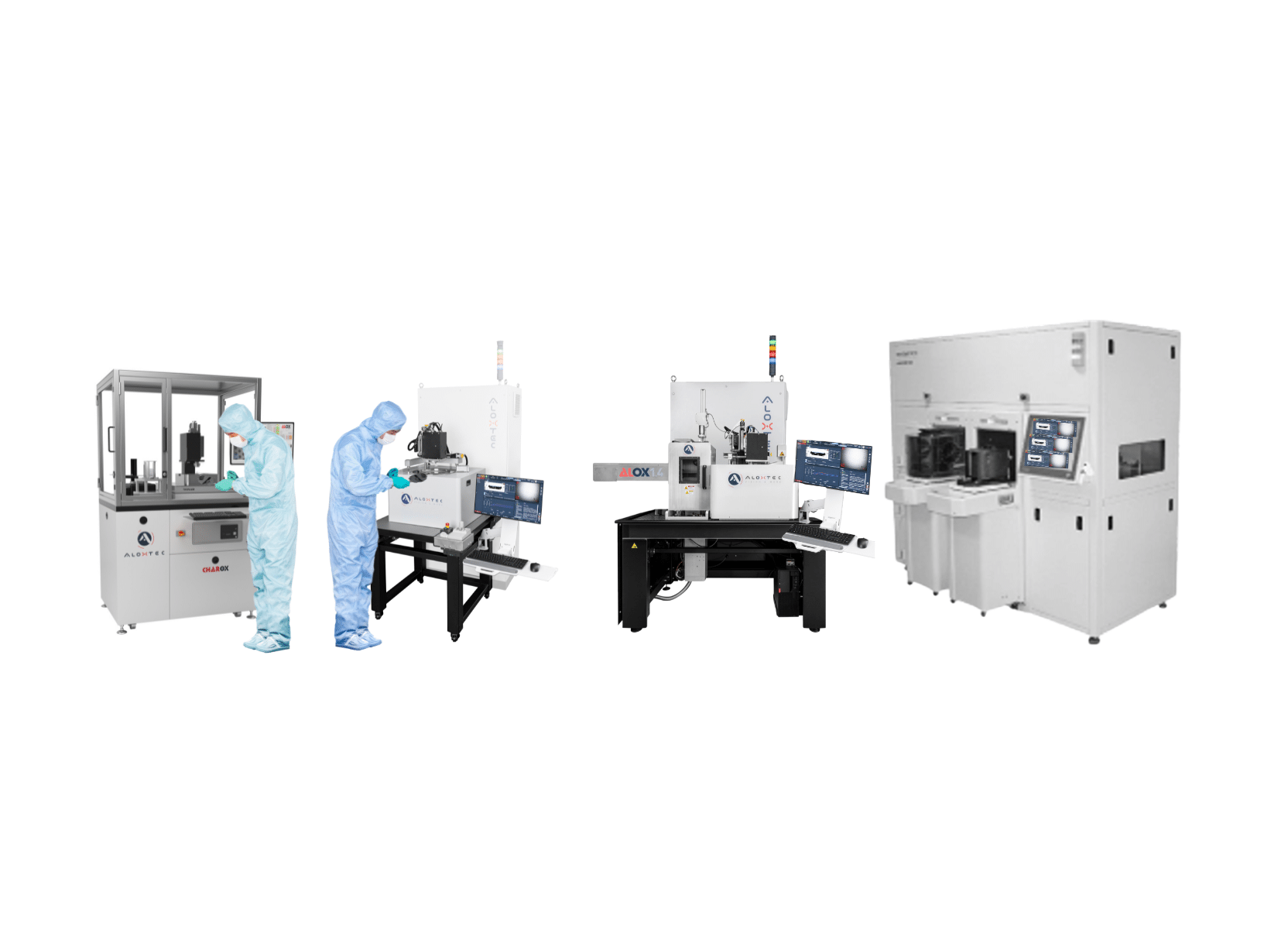
Oxide aperture uniformity is not a secondary optimisation parameter, but a fundamental yield driver in VCSEL manufacturing. While endpoint control ensures the correct average aperture size, spatial non-uniformity across the wafer directly determines how many dies fall within specification. The following questions address the physical origins of non-uniformity and how advanced process control solutions such as UniformPerf© eliminate its root causes.
 Save as PDF